Character Craft: Moral Alignment
Back when I was writing The Red Fletch, I decided to offer up my novel and myself as a practicum client for another book coach in training. They were working on their second practicum, which meant they’d be reviewing my completed manuscript.
I was excited. I signed onto the call, eager to hear what my first book coach had to say. Now, I’d been critiqued before. After two masters’ degrees in creative writing, I was no stranger to the red pen. But my coach’s first question took me by surprise.
She asked: Did you intend for Alys to be a sociopath?Alys, my main character, was not intended to be a sociopath. She was a woman living in the Medieval Era, and faced the violence of the age.
But my coach’s question made me realized I’d taken that too far and changed my character’s moral alignment without meaning to.
What is moral alignment?
This question will be nothing new to anyone who has played Dungeons & Dragons. I’m actually rubbish at that game but this one part of it did interest me… the idea that a character wasn’t just good, neutral, or bad, but that they could be, within those classifications, lawful, neutral, or chaotic. (A neutral-neutral character would just be true neutral. Think apathy till the cows come home.)
So that you have a handy reference, here are moral alignments your character might have:
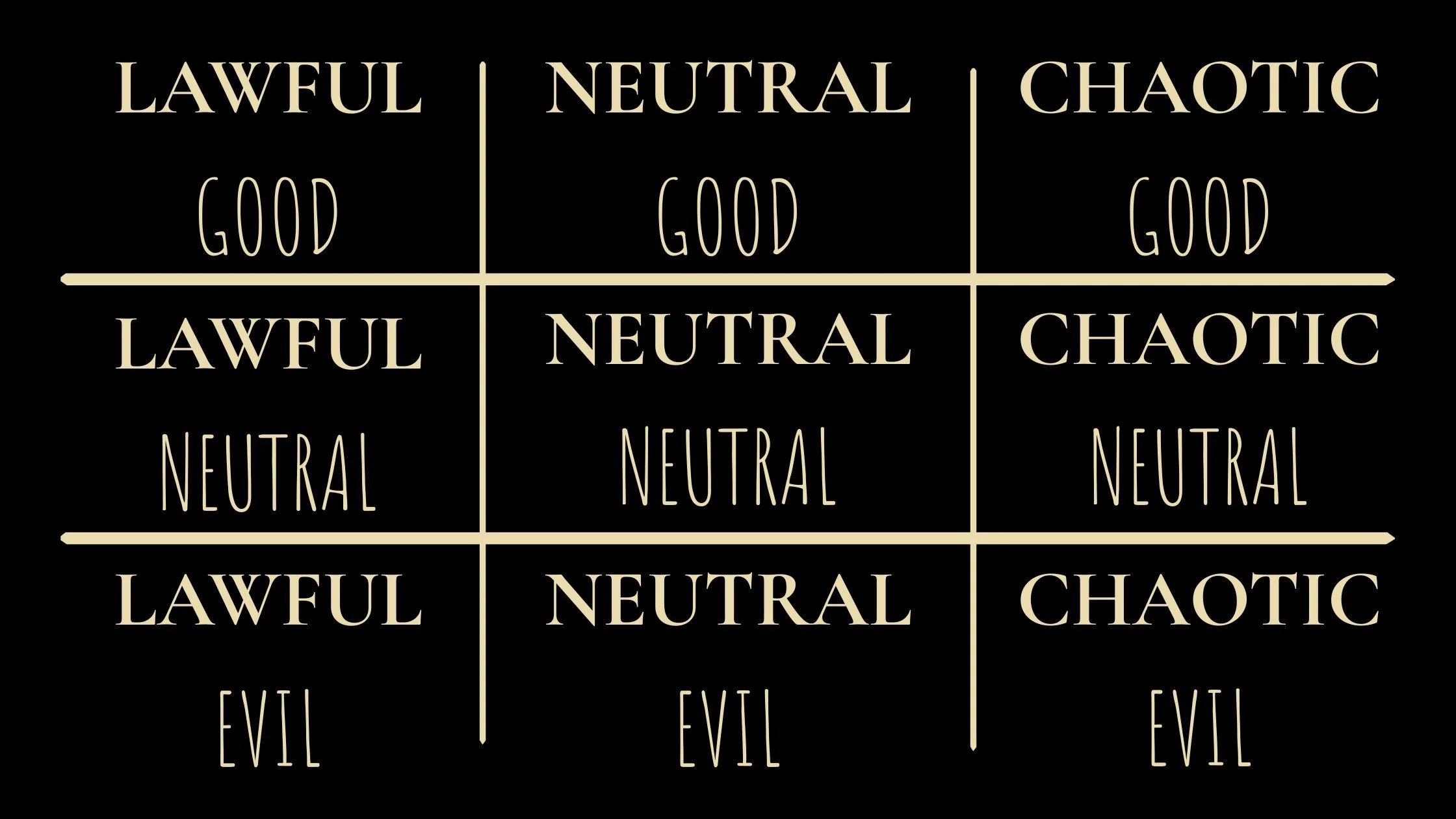
This runs the gamut from saintly to the Heath Ledger’s Joker. Yes, I went there. (He was a brilliant actor, and played the chaotic evil part a little too well.)
I was aiming to have Alys start out in the chaotic good range but she’d slipped through chaotic neutral to at least neutral bad. (As a point of contrast, the Sheriff of Nottingham was lawful evil in my story.)
And… alignment is often a symptom of a character’s wound. For example: A character who believes the Lie "Only the strong survive" (Wound) might lean toward Neutral Evil or Chaotic Neutral until they begin to heal.
Which also means… your character’s alignment isn’t set in stone throughout the entire story. It can shift and change, especially if they’re round and dynamic.
How does moral alignment show up in a story?
Moral alignment shows up through what a character intends and how they act/what they say.
My first iteration of Alys was anti-establishment, sassy, and willing to engage in violence when it suited standing against the establishment.
To shift her into the character I wanted her to be, I toned down her sass just a little bit and kept much of it as internal monologue (what a character is willing to say to people in power can determine where they stand on the lawful to chaotic scale). I also made her react to the violence that was necessary in a way that someone who is not a sociopath might react.
The first time she takes a life – which is accidental – she’s sick to her stomach over it.
Finally, I adjusted her intentions. She’s reluctant to fight, but willing to, especially when it’s for justice, for example.
These changes on the page shifted her morality to how I actually envisioned her.
Sometimes our bias of knowledge gets in the way.
I had Alys in my mind a certain way, but she wasn’t showing up on the page like that. I couldn’t see the difference until my coach pointed it out.
This is because, like all writers, I had a bias of knowledge.
The Alys I’d invented in my head wasn’t a sociopath. She was chaotic good. But just because I saw her so clearly in my mind doesn’t mean she was showing up that way on the page. It took another person, despite my story and craft experience to point out where they thought she seemed sociopathic.
Disclaimer: Nothing wrong with writing a sociopathic character. But it’s not what I intended.
Once my bias of knowledge was no longer in the way, I was able to more easily make the changes I needed to make (to the tune of over 10,000 words removed and rewritten) in order to get Alys on the page to match Alys in my mind.
What’s so important about moral alignment?
Moral alignment of your characters influences how your readers relate to and connect with them. If I had kept Alys the way she was in that earlier draft, it’s unlikely readers would have cheered for her. They may have found her interesting and compelling, but they wouldn’t have been on side.
By changing her, even though she still faced morally ambiguous choices, readers were able to hope for her growth and success. For the themes of my book, this was crucial.
Moral alignment also impacts point-of-view, or the lens through which the story is told.
If a POV character is chaotic bad, it’s going to change how they view the world than if they’re chaotic good.
The other impact moral alignment has is how your character interacts with other characters. In The Red Fletch, Alys sometimes stands at odds with Maid Marian, who is lawful good – at least much more lawful than Alys. This presents moments to poke at their connection and interactions.
Moral alignment matters. And, having your character’s moral alignment present on the page the same way it exists in your mind matters too. It can influence how you connect with readers, both on and off the page.
It pays to explore moral alignment and choose which is right for your character, with intention, and with your bias of knowledge quieted as much as possible.
The Exercise
Writing craft theory is fascinating, but until we apply it to the page, it remains theoretical. Time to get to some writing.
For this exercise, I’d like you to take a scene you’ve written (or write a new scene) and identify what your protagonist’s moral alignment is.
Then, draft another version of the scene where you choose a different moral alignment. Let it filter through any hinge moments and your character’s POV.
Stop guessing how your readers see your hero.
One of the most dangerous hurdles for a writer is the Bias of Knowledge—knowing your character is "good" in your head, while they accidentally read as "sociopathic" on the page. This intensive focuses on bridging that gap using the 3x3 Moral Alignment framework.
Whether you're writing a Lawful Good hero or a Chaotic Evil villain, this individualized feedback ensures your character’s morality, intentions, and actions are working in harmony to keep your readers hooked.
Professional Critique
I will provide a deep-dive review of your exercise (up to 2,500 words), including:
In-line Feedback: Real-time reactions to your character's choices, dialogue, and moral "hinge" moments to see if their alignment is landing.
Audio Feedback: A high-level analysis where I discuss your character’s "vibe" and provide clear steps to ensure your readers relate to them exactly how you intended.
How to Submit Your Work
To ensure I can provide the most helpful feedback, please prepare a brief Moral Alignment Audit to include with your submission:
Intended Alignment: Where do you think this character sits on the 3x3 grid?
The Goal: What do you want the reader to feel about this character's morality? (e.g., "I want them to be a lovable rogue," or "I want them to be a terrifying but logical antagonist.")
Submission Standards:
File Format: Microsoft Word (.doc/.docx), Google Doc link (with "Editor" access), or PDF.
Page Limit: Maximum of 10 pages total.
Formatting: Double-spaced, 12pt font, with 1-inch margins.
File Name: Please use the format: YourName_AlignmentAssignment.
Note: I will email you within 24 hours of your purchase to provide a secure link for your submission. I aim to return your marked-up manuscript and audio feedback within 5 business days.
